HULL_011
MODERN HARMONY: ITS EXPLANATION AND APPLICATION CHAPTER I INTRODUCTORY THE swift current of modern musical art during the last ten or fifteen years seems at first glance to have ruthlessly swept away the whole of the theories of the past. The earnest student may well be excused if he is bewildered completely on rising up fresh from his theoretical treatises to plunge into the music of actual life of the twentieth-century opera-houses, concert-halls, and music-rooms. The sincere mind can hardly be satisfied by the offhand opinions of hide-bound time-servers, who curtly dismiss these modern composers with a deprecatory wave of the hand! The whole of musical history — the initial rejection and later triumph of Monteverdi and Gluck, of Bach and Beethoven, Wagner and Strauss — warns one against the too easy acceptance of the neatly turned epithets of persons who are too indolent to understand, or too indifferent to appreciate, a new kind of music which claims at once wide sympathies and considerable powers of concentration. Music which causes people to "hiss" and "boo" must contain at any rate some vitality, and is preferable consequently to that which speedily reduces the audience to a somnolent passivity. Even on short acquaintance these modern musicians have too much method in their so-called "modernity" to be dismissed thus cursorily. Ex nihilo nihil, and the more deeply our interest is roused, the more we feel convinced that the methods of the leaders of these many modern styles or schools, or whatever we please to call them, are well founded on the rock-bed principles from which all the many secondary laws of art are drawn.
翻訳中...

HULL_012
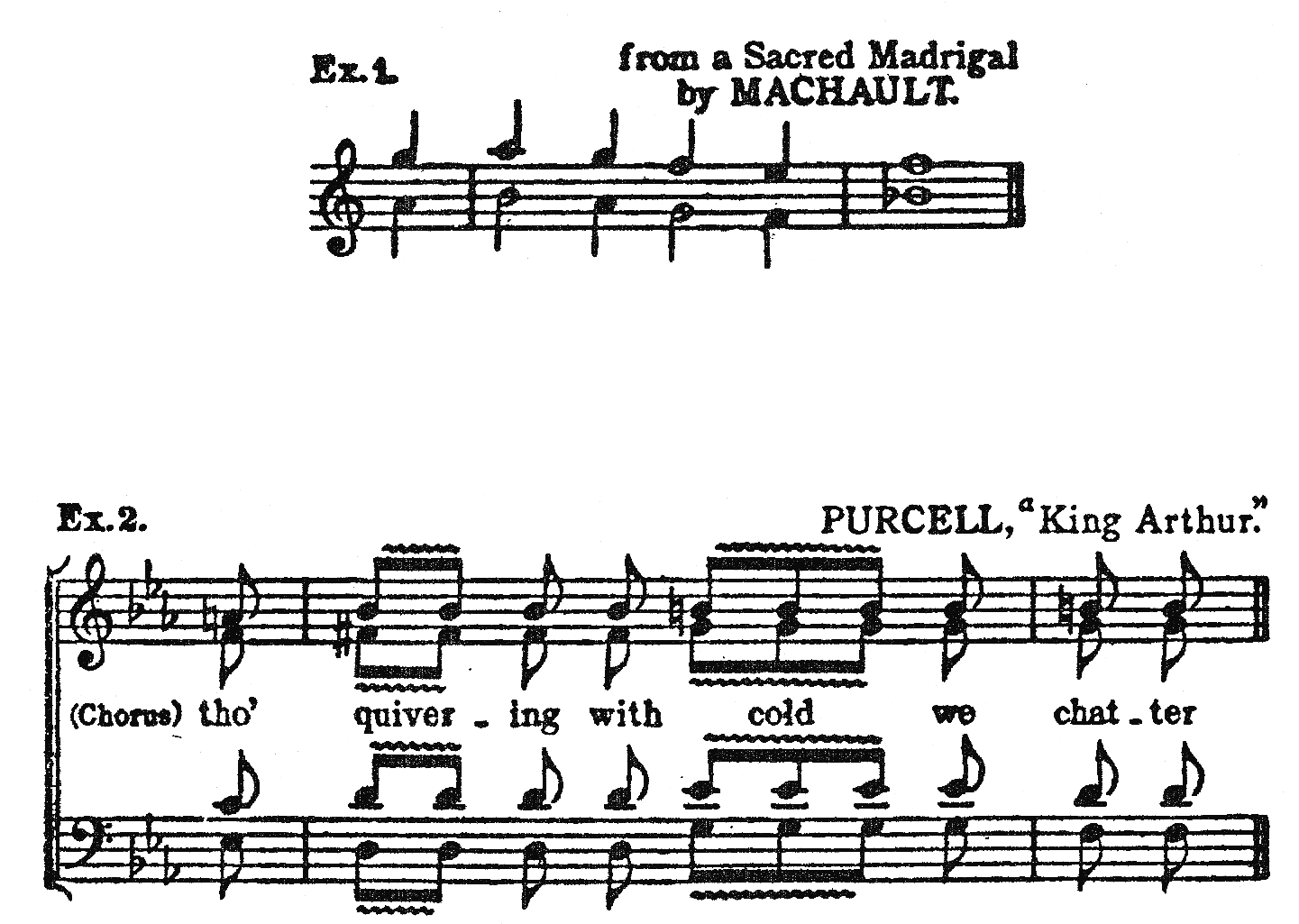
MODERN HARMONY It is the greatest possible mistake to view these modern schools as things separate from the art of the past. Indeed, most of the new traits are legitimate growths out of the art technique of the acknowledged great masters.* Moreover, it does seem as if there were nothing new under the sun. Just as the principles of the twentieth-century "Cubism" in painting were well known some 400 years ago, so the modern methods of part-writing and chord-building all find their prototypes time after time in the pages of the great masters of the past. Debussy's sequences of sevenths are but a reverberation of the practice of Guillaume de Machault in the fourteenth century. Ex.1 p. 4 from a Sacred Madrigal by MACHAULT Striking examples of tonal chords may be found in Purcell (1658-1695), and twelve-note-scale wrestlings in the Elizabethan pieces for the "virginals" by John Bull. Ex.2 PURCELL, "A King Arthur" quivering with cold I have carefully refrained throughout this book from using the term "classical," as commonly applied to Palestrina, Bach, Beethoven, and all the other great ones, as, with the late Mr. Coleridge-Taylor, I deem it unfair to the composers of the present age. In a comparatively new art like music, future generations may well call Parry, Stanford, Mackenzie, Elgar, Debussy, Schönberg and others, "classical."
翻訳中...
HULL_013
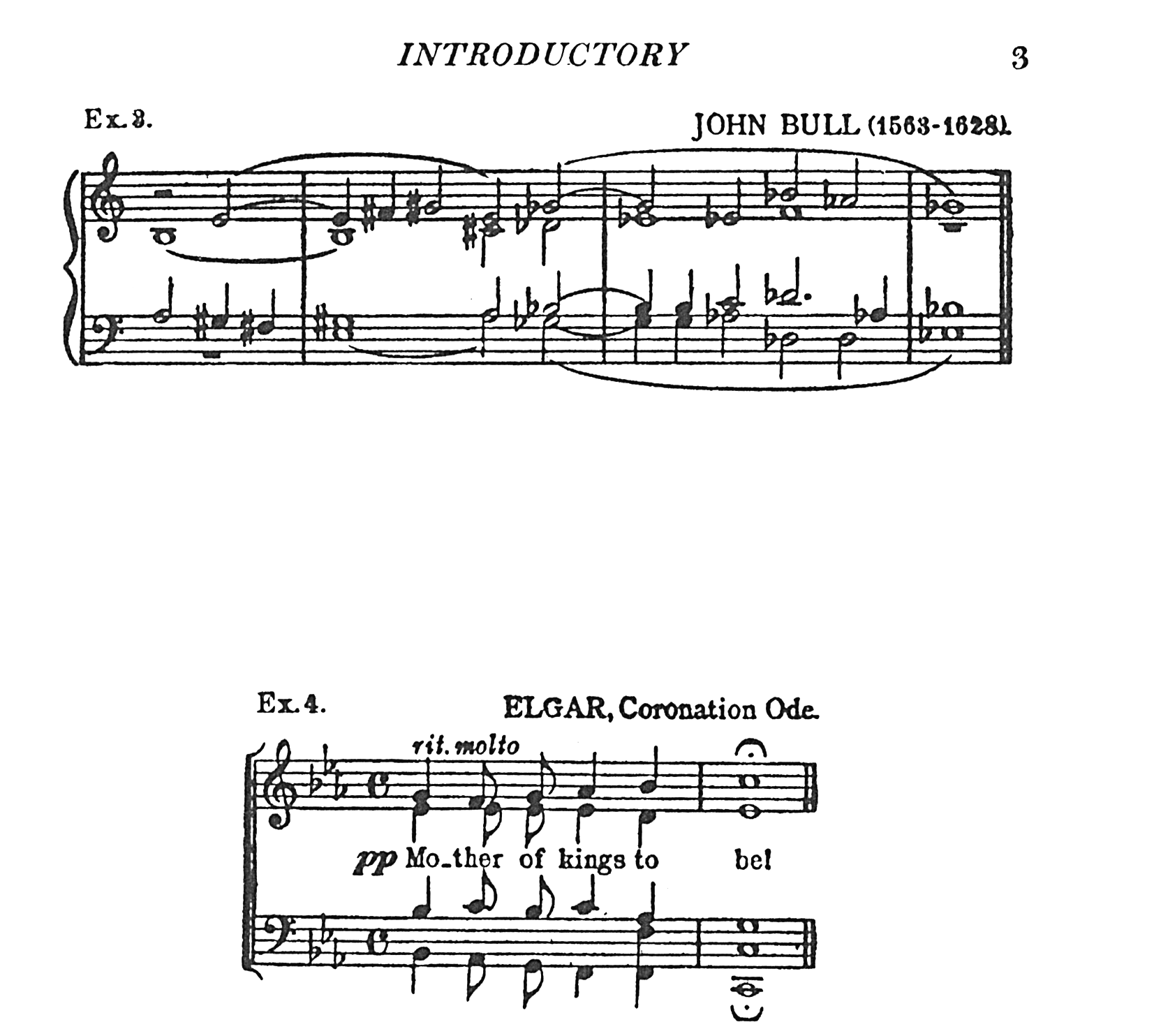
INTRODUCTORY EJL8. Ex.3 JOHN BULL (1583–1628) Bach, Mozart, and Beethoven seem all to have felt the banal and platitudinizing tendencies of the major scale, and were continually glancing towards a minor submediant. Under the same influence Parry frequently prefers his seventh minor, and Elgar, in the minor keys of his first period, invariably chooses the falling melodic form for his rising cadences. Ex. 4. ELGAR, Coronation Ode. *rit. molto . . pp* Mother of kings to be! The first suggestions of the "twelve-note" scale may be found in the violin concertos of Vivaldi and the clavier fantasias and fugues of J. S. Bach, whilst its use as a vague tonality in the introduction to a more diatonic theme by Mozart in his well-known C major Quartet, finds its echo in the recent Kammer-Sinfonie of Schönberg (see Chapter XV.). All music is impressionistic in aim, but amongst the first pieces of Impressionist technique are surely the shake in Beethoven's E minor Sonata (final movement) given on p. 4, and the ending of the first movement of "Les Adieux" Sonata given on p. 131. Frequent additions to the chordal vocabulary have always been the rule, and whereas we find Bach developing unending resonances out of the "diminished seventh" (without ever suspecting a Dominant "root"), Beethoven's favourite "minor ninth" chord finds its parallel in the structure of two equal fourths favoured by Debussy, Schönberg and Ravel, in Scriabin's chord of two unequal fourths, and in Strauss's "tonal" combinations.
翻訳中...
HULL_014
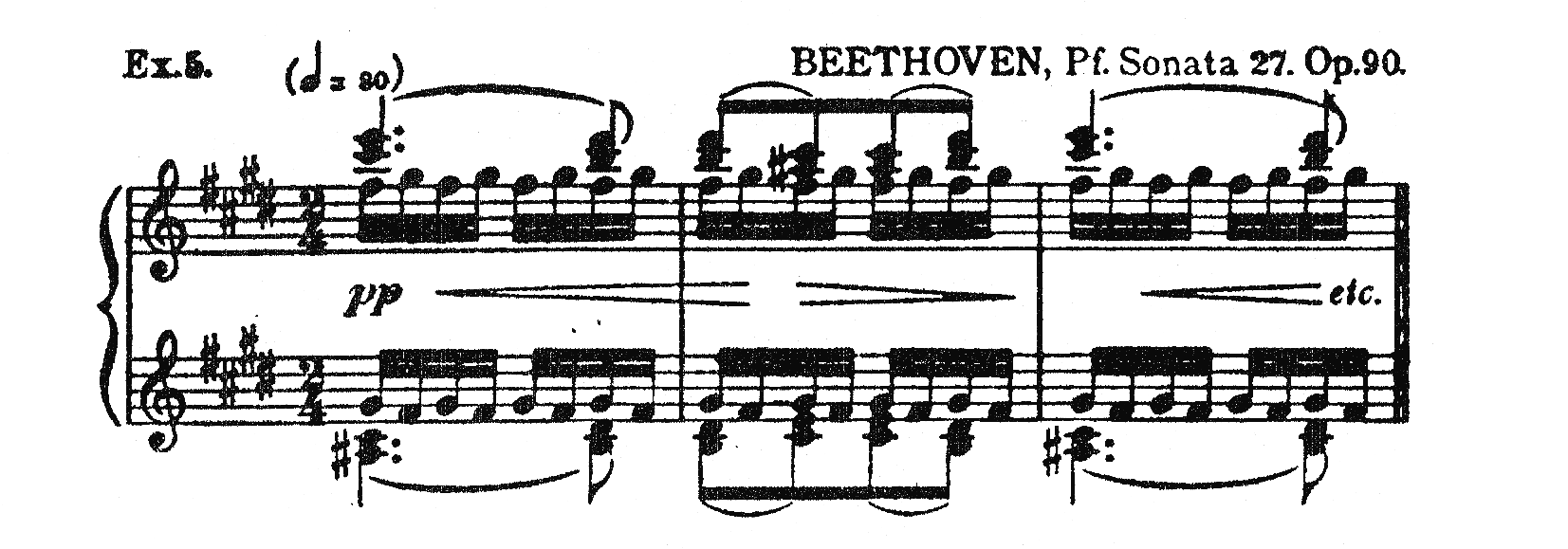
4 MODERN HARMONY Ex. 6. BEETHOVEN, Pf. Sonata 27. Op. 90. Although considerable weight must be laid on the close connection of the present art with that of the past, yet we must approach the newer harmonic tendencies with an absolutely open mind. So rapid and numerous have been the recent developments that barriers have been broken down in all directions, whilst on the other hand an almost completely new musical language has been invented. We must avoid the predicament of the people described by Mr. H. G. Wells as so much engaged in gazing towards the past that they walk into the future backwards. Art must ever be in a fluid state if it is to live, and whilst profiting by the experience of the past, we must ever be watchful of its course in the future. So much harmony teaching is founded on mere text-book formalities that there is little, if any, appeal to the evidence of the aural intelligence, the real arbiter in all matters of musical taste. It is the empirical method which makes the theory of the music of the later composers so difficult, and we cannot suppose that all of the explanations set down herein were present in the composers' minds at the time of conception, or that they may even be acceptable always to the composers themselves. The system of teaching harmony by attaching names to the chords often produces an altogether false way of regarding music. No chord in itself conveys any meaning whatsoever. It can give a vague impression (see Chapter X.), but thought in music can only be transmitted by chordal succession and forward movement, and the chord, however wonderfully arranged, has value only in this light.
翻訳中...
HULL_015
INTRODUCTORY Impatience with set rules has always been a strong trait with composers, from the time of Mozart's travesty of a fugue in his "Ein Musikalischer Spass" to Wagner's caricature of Beckmesser; from Mendelssohn's rejection of a root to the first chord of the "Wedding March" to the clever satire in Strauss's tone poem, "Also sprach Zarathustra," and his opera, "Ariadne in Naxos." Bach wrote his consecutive fifths in the D minor organ Toccata because he liked them, and theory must consequently adapt itself to explain them. Schubert, Beethoven, and Dvorak loved to dally between the close relations of the major key and its tonic minor, and yet people are worrying still about a minor key related only by the merest accident of key-signature. The many inadequacies of our system of notation are responsible for much miscomprehension, and composers must not be blamed for using our rather clumsy notational method in unconventional ways. The "twelve-note" and the "tonal" scales strain the system almost to breaking-point, and it is curious to find people asserting that therefore the notation is all right and the music all wrong. How much of composers' messages has been lost in such a cumbersome and unscientific transmission will never be known. The four widest divergencies from the old practices found in modern music are: (a) Other systems of chord-building than that founded on the superposition of unequal thirds (see Chapter VIII.). (b) The "twelve-note" scale as the basis of harmony and melody. This must be distinguished from the "chromatic" scale (see Chapter IV.). (c) The "tonal" scale with its equal steps (see Chapter V.). (d) The greater musical intelligence constantly demanded from the hearer by altered and added notes in chords (Chapter VII.), and by the growing practice of the elision of all unnecessary steps and chords (see Chapter IX.). To a large extent the literal definition of "language" as a means of making oneself understood may be accepted in music.
翻訳中...

HULL_016
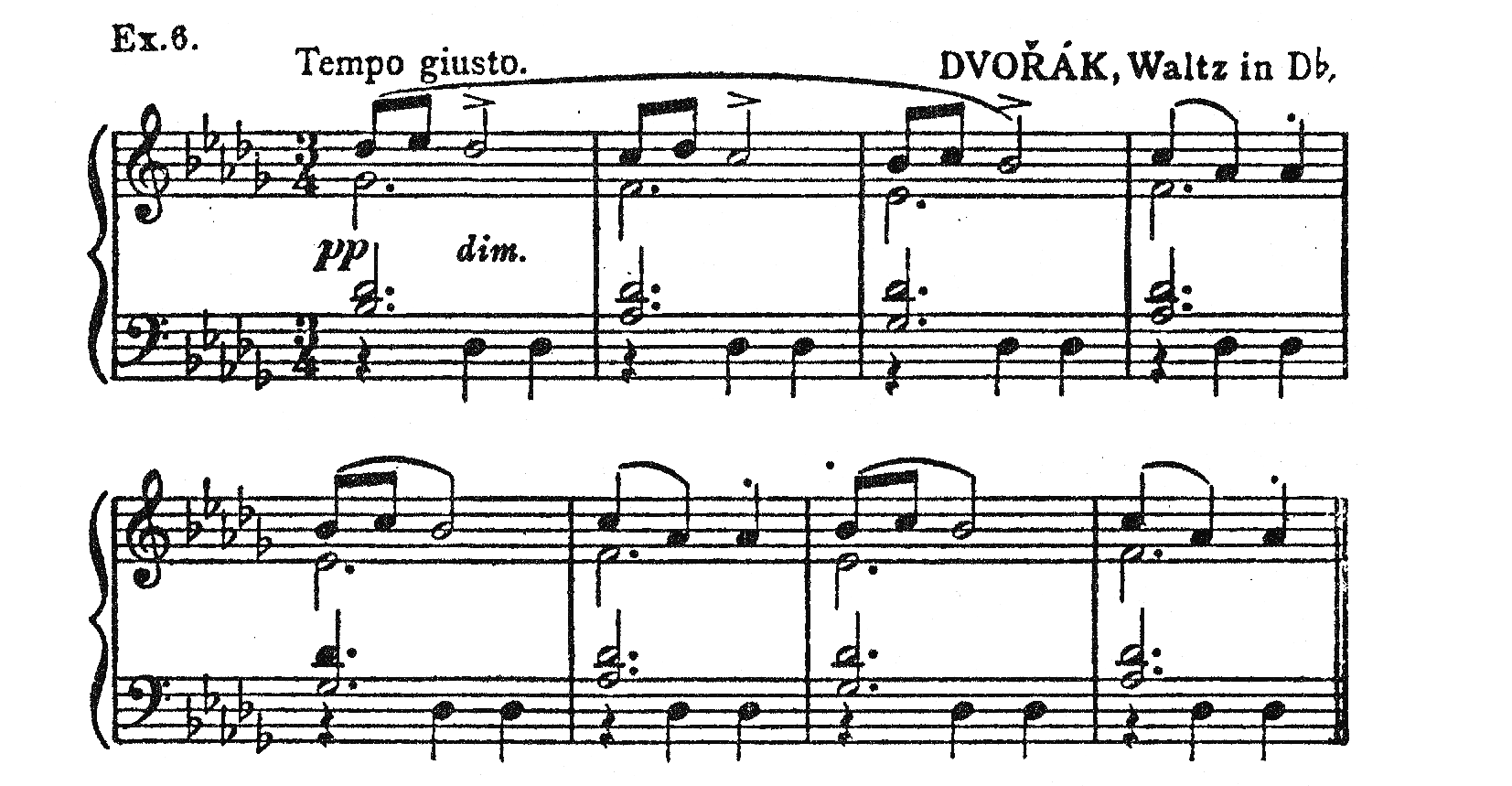
MODERN HARMONY The perception of sincerity and obvious purpose and design will readily atone for much in the way of less regular sequences, persistence in uncustomary procedures, waving aside of preparations, etc. "The spirit rather than the letter," and "Broad principles before the secondary laws founded on them," seem to be the watchwords of the musical Progressivists. Style and finish are but as the sheath which covers the sword, and there are times when the weapon has to be carried unsheathed. No one would demur at the special effects of the fifths in the following: Ex. 6. Tempo giusto. DVORAK, Waltz in D♭, nyf rr Hi Kpp\ dim, ^ ^ r r i* r r 1 P. |j {, M j ]
翻訳中...
HULL_017
INTRODUCTORY 7 speech natural to him, aiid which can be understood by thepeople to whom he addresses himself. The Exer-Stndent c ^ ses a ^ the en( ^ of this book are not intended toindicate that he should write in this or that style,but in order that he shall be able to adopt a newer techniqueif he wishes to do so, and, more important still, that by a closerknowledge of the newer technique, much of the mystery ofthe language shall be dispelled, by which means alone thereal value of the musical thought may appear.The modern practice will be seen to have its roots embeddedin the older systems, just as the English language has itsfoundations in the Latin tongue. An Early Victorian rule ofetiquette forbade the quoting of Latin without " apologizingand translating to the ladies." Will the playing of diatonicmusic come to need a similar apologia ?
翻訳中...
HULL_018
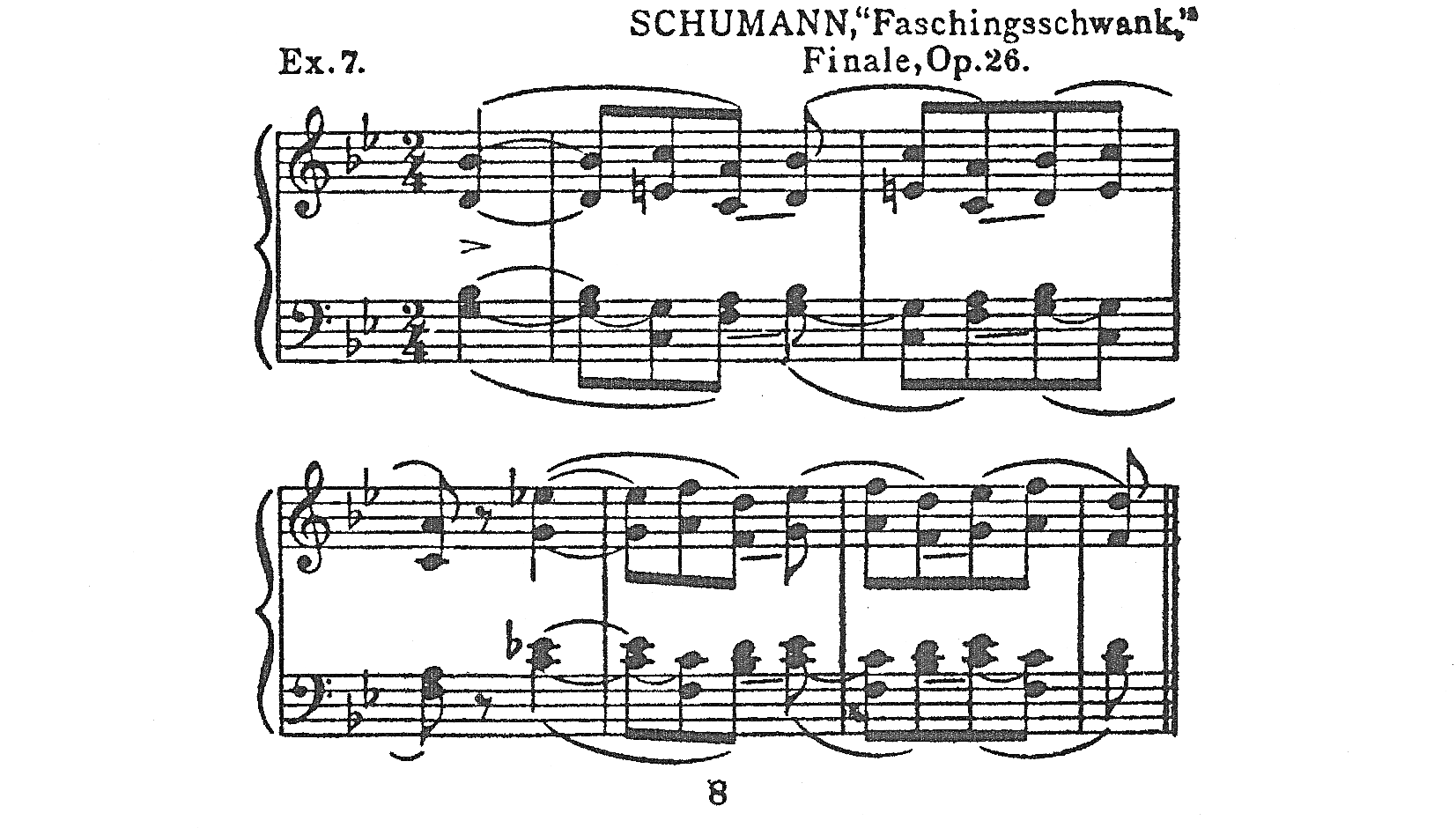
CHAPTER IIGREATER FREEDOM ON THE OLD LINESIN this age, when everything is thrown into the crucible andtested, it is only natural that composers should show anincreasing"^ sire to break through many of the rules hithertoalmost universally respected. One cannot doubt that there issome deeply lying principle under the many exceptions to therule forbidding parallel fifths and octaves. The plea that theidea oi' part-writing ceases to exist when two orConsecutive more parts run in consecutive fifths hardly seemsto hold good, as this depends entirely on the dis-tribution of parts and on the spacing very largely also onquestions of accent, and considerably on the style of the restof the harmony. The punctuation and phrasing accounts forthe consecutive fifths in the following example by Schumann,whilst the cadential effect destroys the feeling of con'secutivesbetween (a) and (c), and the similar motion to the fifth from(6) to (c) in the Somervell song : Ex.7. SCHUMANN "Faschingsschwank."Finale,Op.26.
翻訳中...
HULL_019
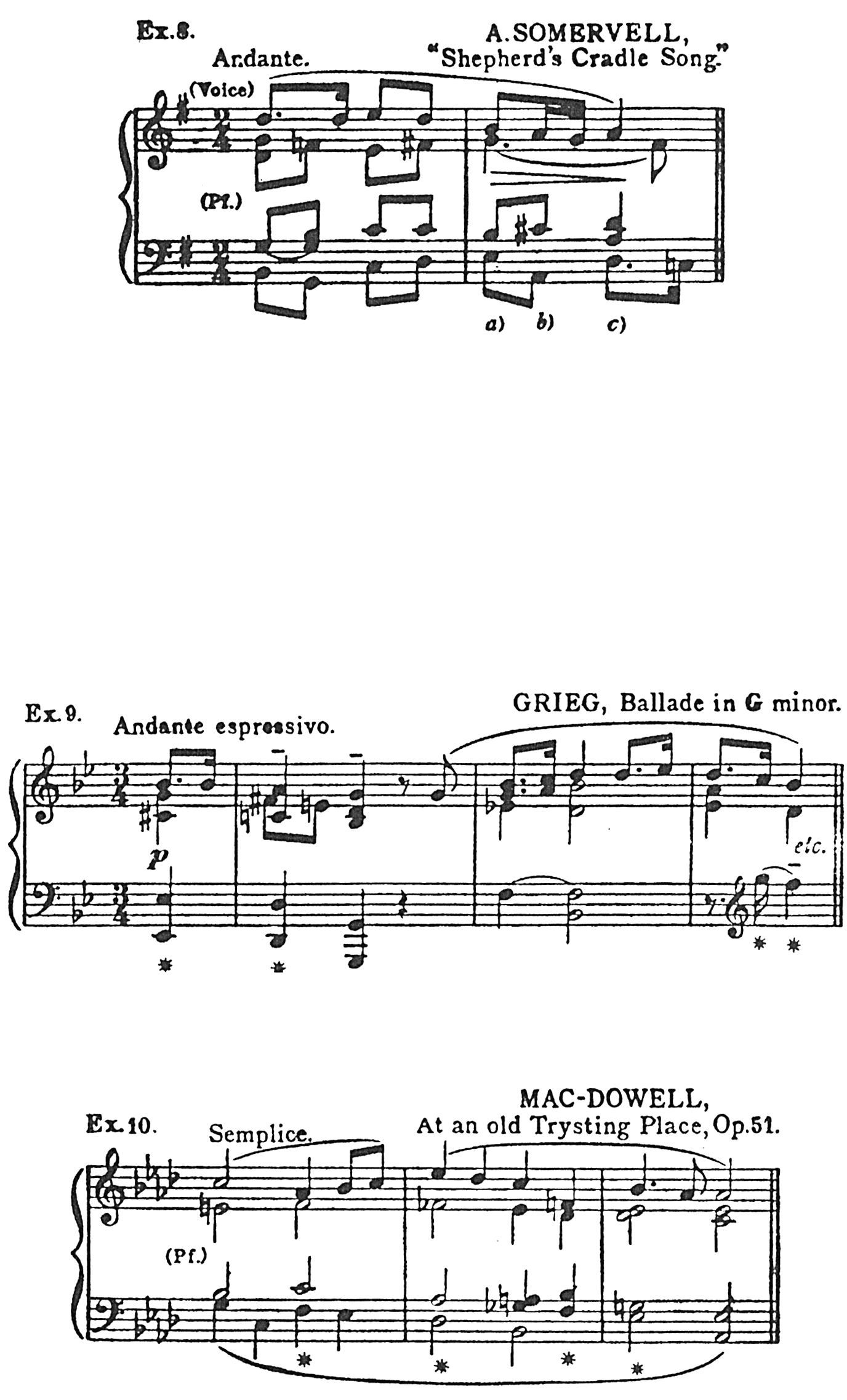
GREATER FREEDOM ON THE OLD LINESEi.8. Andante..(Voice) A.SOMERVELL,Shepherd's Cradle Song!* a) b) c) Moreover, certain fifths scorn to have very special qualities,and the following passages are worthy of study in thisdirection. The Chopin fifths (Example 11) are both in majorchords. One of the MacDowell fifths is in a minor chord,whilst the Grieg consecutives occur in discords. The use ofconsecutive fifths in the Chopin Mazurka in C (see p. 118) toois very instructive. Ex.9 Andante esprassivo. GRIEG, Ballade in G minor. \Ex - 10 ' Semplice. J MAC-DOWELL, A.t an old Trysting Place, Op. 51.;j f f(Pf.) PP
翻訳中...
HULL_020
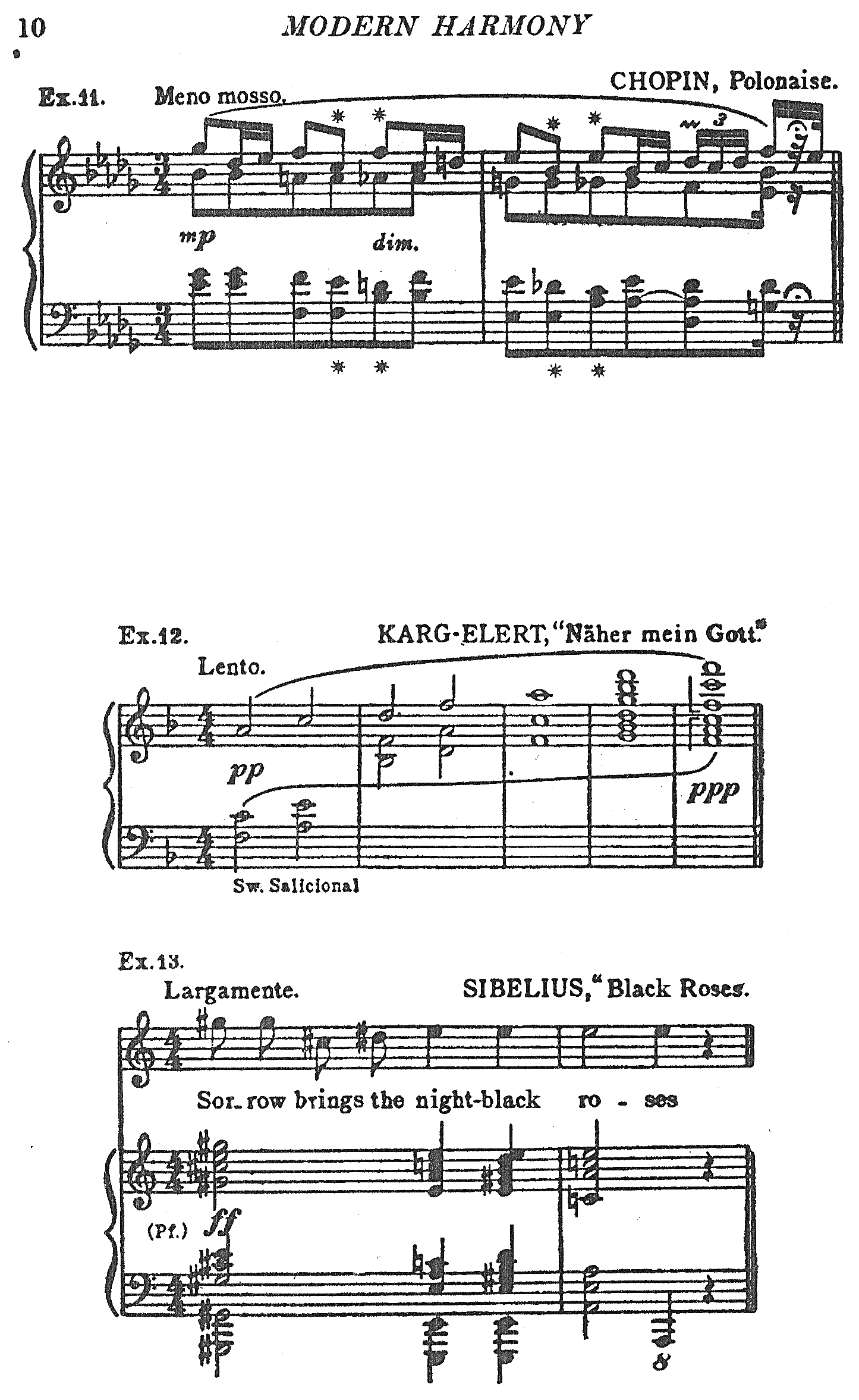
10 MODERN HARMONYEx.11. Meno mosso^ CHOPIN, Polonaise.T i * *The alternation ol major and minor tiiirda in passages likethe Karg-Blert extract produces an altogether differenteffect from the consecutive minor common chords in the Sibelius song, and also from the open octaves and fifths in Example 14. Ex.12. KARG-ELERT,"Naher mein Gott"J. Sw. Stlicicnal Ex.ia.Largamente. SIBELIUS," Black Rows.r MSoi_ row brings the night-black ro . ses My 4tx 4 a w
翻訳中...